
The principle of service orientation from the general administrative procedure law through the prism of a specific administrative dispute for a license for the exploitation of mineral resources
Introductory
remarks
This
analysis covers Judgment
U.6.No.575/2019 of the Administrative Court from March
2020 (hereinafter: the Judgment), which resolved the administrative
dispute between:
EUROMAX RESOURCES DOO Skopje (hereinafter: Concessionaire) and
The State Commission for decision-making in administrative procedure and procedure from employment relationship in the second instance (hereinafter: Second-instance Commission).
The
administrative dispute at hand was initiated against Decision UP. number
0810-102 of the Second-instance Commission. With this Decision the
Second-instance Commission rejected the previously field appeal against the
first instance decision of the Ministry of Economy. With the first instance
decision the Ministry of Economy, on the other hand, rejected the
Concessionaire’s request for a permit to exploit mineral resources.
Therefore, the administrative
dispute at hand was quite perplexed. It was preceded by a first-instance and
second-instance administrative procedure related to a permit to exploit mineral
resources. Such a permit could only be issued to entities who have previously
acquired a concession for exploitation of mineral resources. Thus, the
administrative dispute was also preceded by a Governmental decision for
concession for exploitation of mineral resources.[i]To
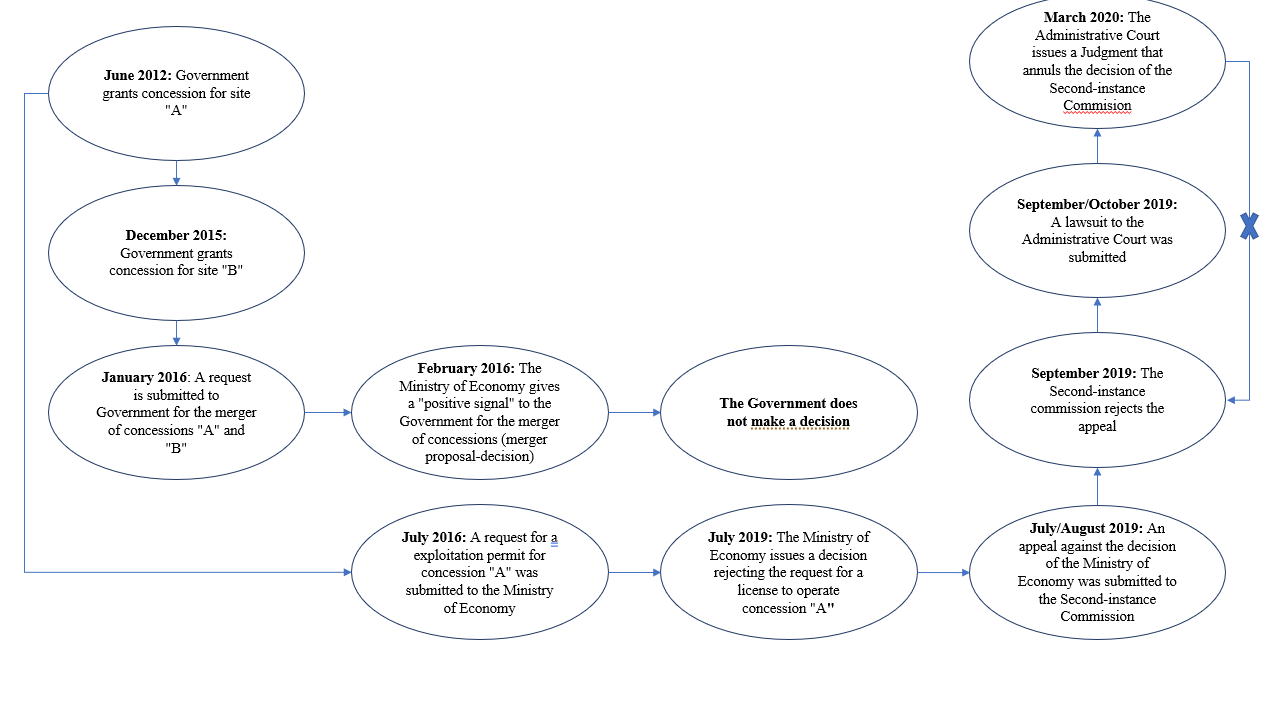
make the chain of events easier to understand, a illustrative representation is
offered bellow.
The
Judgment is significant because the Administrative Court, in such a complex
case, directly applies the principle of service orientation from the Law on General
Administrative Procedure (hereinafter: LGAP).[ii] In addition, the
Administrative Court offers a broad interpretation of the provisions of the LGAP concerning the previous (prejudicial) question. Moreover, the Judgment also
serves as a positive example due to the detailed reasoning contained in it. The
following text will focus primarily to the Administrative Court’s
interpretation of the principle of service orientation.
Background:
events that preceded the administrative dispute
One can learn about the events which
preceded the administrative dispute by studying the Judgment itself.
First
of all, the Concessionaire acquired two concessions for the exploitation of
mineral resources at two different but adjacent locations. One concession was
obtained in 2012 (hereinafter: Concession "A"), and the other
in 2015 (hereinafter: Concession "B").[iii]Both
concessions were given for exploitation of copper and gold as metallic mineral
resources. Taking that into account, according to Article 54 of the Law on
Mineral Resources,[iv] the Concessionaire was obliged – within 4 years from the day of the conclusion
of the concession agreements – to submit requests for a permit to exploit
mineral resources to the Ministry of Economy. The failure to submit the
respective request, on the other hand, would have been a basis for unilateral
termination of the concession agreements, as per Article 51 of the Law on
Mineral Resources (paragraph 1, subparagraph 8).
In
January 2016 (while the 4-year deadline to request a permit for exploitation of
mineral resources for Concession “A” was still running) the Concessionaire,
considering the legal conditions were met, submitted a request to the
Government for the merger of the two concessions. According to Article 61,
paragraphs 1 and 2 of the Law on Mineral Resources, merging of concessions is
allowed if the following conditions are met: (*) the concessions are adjacent (next to one another); (*) both concessions
are given for the same exploring location (*) both concessions have the same
holder/owner; (*) both concessions are given for the same type of mineral raw
material. The merger is allowed by the Government after a previous merger
proposal from the Ministry of Economy. If the concessions are merged, the new
concession will last as long as the shorter of the two concessions. In the case
at hand, the Ministry of Economy submitted a proposal for merging the
concessions to the Government in less than 30 days from the day when the
request for merging was submitted. The Government did not reach a merger
decision for several years afterwards.
In
July 2016, while still waiting for a decision on the merger of Concessions
"A" and "B", the Concessionaire submitted a request to the
Ministry of Economy to issue a permit for the exploitation of mineral resources
on Concession "A". This request was updated in March 2017. Only in
2019 (almost three years later) did the Ministry of Economy issue a decision
rejecting the request for an exploitation permit for Concession "A".
The main reason for rejecting the request was that the Concessionaire did not
attach all the necessary documentation (according to the Law on Mineral
Resources) to the request. The Concessionaire filed an appeal against this
decision to the Second-instance Commission. The appeal was based, among the
rest, on two main pillars:
the request should not have been rejected due to the fact that not all the necessary documents were attached to it, considering that the failure to attach some of them is not the Concessionaire's fault
onamely, some of the documents that should be attached to the request are obtained from other public authorities
the concessionaire requested the respective documents from said other public authorities in a timely manner, but did not receive them until the day the request for exploitation was submitted;
The Ministry of Economy should have temporarily stopped the procedure for issuing a permit for exploitation until the Government decided on the request for the merger of the two concessions
again, in the context of the attaching documents to the request for the exploitation permit, the procedure should have been stopped because the documentation submitted alongside the request would have been different depending whether the Government allowed the merger
for example, projects and other similar documents would have been different, depending on whether they refer only to Concession "A" or cover the area of both concessions, after they are merged.
The
Second-instance Commission did not accept the appeal of the Concessionaire and
reached a Decision in favor of the Ministry of Economy.
The
Concessionaire therefore filed a lawsuit against the Decision of the
Second-instance Commission, initiating the administrative dispute that is
analyzed herein. The Administrative Court took a different position from the Second-instance
Commission and annulled its decision.
For
the chain of events to be easier to understand, the following illustration was
prepared:
The
Judgment and reasoning of the Administrative Court
As stated above, the Judgment of the
Administrative Court annulled the Decision of the Second-instance Commission.
The Administrative Court offered several arguments as to why the
Second-instance Commission applied the substantive and procedural law
incorrectly. In addition, the Administrative Court ruled that the
Second-instance Commission determined the facts of the case improperly.
However, at this occasion we will focus mostly on the interpretation the
Administrative Court gave on the application of two provisions from the LGAP:
Article 9 in which the principle of service orientation of public authorities is stipulated and
Article 95, which regulates the previous (prejudicial) question.
Article
9 reads: "When public authorities decide on administrative matters, they
are service-oriented to fulfill the rights and interests of the parties".
As for Article 95, we will outline
only the most important paragraph 1 which reads: "(1) If the public
authority carrying out the procedure comes across an issue whose resolution is
a prerequisite to decide on the case itself, and the same issue is an independent legal issue for
which another public authority or a court is competent to decide (hereinafter:
previous issue), the public authority carrying out the administrative procedure
temporarily stops the procedure until the previous issue is resolved and
notifies the party thereof”.
The
Administrative Court starts its interpretation from the principle of service
orientation.
According
to the Administrative Court, the Ministry of Economy should not have rejected
the Concessionaire’s request for exploitation because it did not submit in
addition to the request all the documents prescribed by the Law on Mineral
Resources. Namely, some of the documents that the Concessionaire did not submit
are (supposed to be) issued by other public authorities in the country, and the
Concessionaire submitted appropriate requests for them. Hence, the
Concessionaire, as the requestee to the Ministry of Economy, has fulfilled its
obligation to obtain the specified documents. In other words, it is not the
Concessionaire's fault that other public authorities did not issue the
documents he requested in a timely manner, so he could not even attach them to
the exploitation request submitted to the Ministry of Economy. On the contrary,
according to the Administrative Court, the Ministry of Economy, as the competent
authority for the implementation of the concession agreement, should have,
through the Government, requested an explanation from the other public
authorities why they did not act on the requests for the issuance of documents
to the Concessionaire. This interpretation of the Administrative Court could
even be qualified as revolutionary.
Why?
Because the Administrative Court gave a new practical dimension to the
principle of service orientation; namely, the principle of service orientation
is not just a platitude according to which the officials from the public
authority carrying out the (administrative) procedure have a correct attitude
towards the party (in correlation with other principles, and especially the
principle of active assistance to the party) but it also implies active
communication and cooperation between several public authorities.
Namely,
it is stipulated in numerous material laws and by-laws it that the
natural/legal person has to submit additional documents (evidence) along with a
certain request that initiates an administrative procedure. Those additional
documents (evidence) are issued by other public authorities. In other words, to
obtain an administrative act, another previously issued administrative or real
act often appears as a prerequisite. In such cases, according to the
interpretation given by the Administrative Court, the public authority that
decides should not immediately reject the request of the party just because it
did not attach to the request all the documents (evidence) that are mandatory
according to the laws and/or by-laws. On the contrary, the public authority
that received the request should, if dully informed by the party, check whether
it really requested the missing documents (evidence) from the other public
authorities in a timely manner before submitting the request. If the party
requested the appropriate documents (evidence), but did not receive them in
time, the public authority that receives the request should try to ensure their
issuance through official communication with the competent authorities.
Especially when the party had to submit the request by a given date due to the
existence of preclusion deadlines.
To
make this interpretation easier to understand, we will give two hypothetical
examples:
Example 1: A concession has been granted for the construction of a first category building. Construction must be completed by 2024. According to building regulations and environmental protection regulations, for the Ministry of Transport and Communications to approve a first category building it is often necessary that the Ministry of Environment and Physical Planning has previously approved (by its own decision) an environmental impact study. The concession holder submitted its environmental impact study to the Ministry of Environment and Physical Planning in 2021, but even after a long period of time, it did not receive a decision approving it. In such a case, in order not to miss the deadlines stipulated by the concession agreement, the holder of the concession should be able to submit an application for construction approval to the Ministry of Transport and Communications without the decision approving the environmental impact study. It will explain to the Ministry of Transport and Communications, in the request itself, that despite the timely creation of an environmental impact study, it has not yet been approved. Furthermore, communication continues between the two ministries.
Example 2: Every year the Ministry of Education and Science announces a Call for awarding scholarships to full-time students enrolled in first-cycle undergraduate studies at public and private universities in the country. The students are requested, in accordance with the previous Calls, to attach certificates of passed exams issued by their faculties to the application to the Ministry of Education and Science. In such case, if the student applied to the Call without the respective certificate, and there is proof that (s)he submitted the request for its issuance to his/her faculty in a timely manner, the Ministry of Education and Science should not reject his/her application. On the contrary, the Ministry of Education and Science should contact the specific faculty to request the student's certificate of passed exams. This, in fact, would be in accordance with the LGAP whose article 56, paragraph 1 reads: "Evidence and data are considered to have been submitted by the party with the request when another authority keeps official records for the same, and the authority carrying out the procedure is responsible for obtaining them ex officio electronically [...]". Although it is evident that the Ministry of Education and Science does not consistently apply Article 56, paragraph 1 of the LGAP, taking into account that it still requires the delivery of certificates for passed exams in order to apply to the Call, in the context of the principle of service orientation, it should establish communication with the faculties in the cases when they are late in issuing their documents (certificates for passed exams) to the students.
This
interpretation of the Administrative Court should be further elaborated by
scientific community, considering the practical implications for the public
authorities and the parties in general (not only in the proceedings arising
from the Law on Mineral Resources but in general). In any case, it is positive
that the Administrative Court provided a broad interpretation of what the principle
of service orientation would mean specific cases, and thus put the parties in a
more favorable position.
Secondly,
regarding the application of Article 95 of the LGAP, which regulates the
institute of a previous (prejudicial) issue, the Administrative Court concluded
that in this particular case the merger of the concessions (which is decided by
the Government) is a previous issue with regard to the issuance of an
exploitation permit (which is decided by the Ministry of Economy). The logic
behind this interpretation is the following: if the Government allows the
merging of concessions, the request for issuance of an exploitation permit will
be extended and will apply to both concessions held by the Concessionaire. Moreover,
as the Administrative Court found, the Government decides on the merger of the
concessions based on a previous proposal of the Ministry of Economy - and such
a proposal was already given. In other words, the Ministry of Economy is acting
contradictory to itself in the case: on the one hand, it proposed to the
Government the merging of the concessions, and on the other hand, it did not
appreciate that it should temporarily stop the procedure for issuing a request
for exploitation until the Government acts on its proposal.
This
way, the Administrative Court set out high standards for the work of
administrative and public bodies in general when deciding on the rights and
legal interests of the parties. This approach should be maintained both in the
proceedings arising from the Law on Mineral Resources and in other proceedings.
Also, this approach should be maintained by the Higher Administrative Court
when deciding on second-instance administrative disputes.
Concluding
remarks
There
is no doubt that the Law on Mineral Resources is very complex and numerous
disputes between public authorities and concessionaires of mineral resources
can arise from it, especially when multiple administrative procedures for the
same concessions are conducted in parallel. However, the Administrative Court,
with the analyzed Judgment, set high standards how the LGAP should be
interpreted and applied so that if fills the gaps from the Law on Mineral
Resources. Especially in terms of the broad interpretation how the principle of
service orientation of the LGAP should be applied in individual cases, but also
when applying the LGAP’s provisions for previous (prejudicial) issue. The
approach of the Administrative Court in this case should be serve as an example
in the future, both for the Administrative Court itself but also for the Higher
Administrative Court. In the longer term, however, it should serve as an
example for advancing the operations of the public authorities vis-à-vis the
citizens (and legal entities).
[i] When it comes
to the exploitation of mineral resources, according to the provisions of the
Law on Mineral Resources, an entity should first obtain a concession for exploitation,
and only then request a permit for exploitation. Moreover, the concession and
the exploitation permit should refer to the same mineral resources.
[ii] Official Gazette no. 125/2015.
[iii] According to the article: https://www.slobodnaevropa.mk/a/%D0%BD%D0%B5%D0%B8%D0%B7%D0%B2%D0%B5%D1%81%D0%BD%D0%BE%D1%81%D1%82-%D0%BE%D1%82%D0%B2%D0%BE%D1%80%D0%B0%D1%9A%D0%B5-%D1%80%D1%83%D0%B4%D0%BD%D0%B8%D0%BA-%D0%B8%D0%BB%D0%BE%D0%B2%D0%B8%D1%86%D0%B0-%D1%88%D1%82%D1%83%D0%BA%D0%B0/30992739.html (last visit: 16.10.2022).
[iv] The Law on
Mineral Resources was published for the first time in the Official Gazette no.
136/2012, and the last amendments were
published in the Official Gazette no. 99/2022.