
The case of Oluić v. Croatia – application no. 61260/08
1. Basic information and circumstances of the case
The
applicant with residence in Rijeka, R. Croatia, complained about the noise made
by a coffee
bar that was open in a part of the house where she
lived, which part was owned by another person. The complainant turned to the
Sanitary Inspection with a notification that her apartment was constantly
exposed to excessive noise from the bar F., which was open every day from 7 am
to midnight.
In October 2001, during the night hours, the measurement
made by independent experts again showed that the noise from the
bar F. exceeds the permissible level by
1.8 dB to 6.9 dB depending on the exact place of measurements. The
complainant also invited the Sanitary Inspectorate to measure the noise, and it
was found that the level of noise was significantly higher than the permitted
one, and the company that managed the bar was ordered to take concrete measures
to reduce it.
Taking
into account that the noise situation was not improved, the complainant started
multi-year proceedings not only before the administrative authorities, but also
before the Administrative and Supreme Court.
The
procedures before the competent authorities took a long time and were
unsuccessful, after which the applicant filed an application before the ECtHR. The
appellant argued that she had adequately exhausted her available remedies and
that all other remedies would be superfluous. In addition, she claimed that the
level and continuity of
noise was
such that it met the criteria for
a violation falling within the scope of Article 8 of the Convention. The
Court found a violation of Article 8 because the Convention aims to guarantee
rights that are "practical and effective" and not "theoretical
or illusory".
2. Application to the ECtHR for alleged violation of article 8 of the Convention
The
applicant complained that the State had failed to protect her from excessive
noise and from being disturbed at night at her home by a bar operating in a
part of the house she inhabited. The applicant argued that she had properly
exhausted available remedies and that any other remedies would have been
redundant. She further argued that the level of noise had been such as to fall
within the ambit of Article 8 of the Convention. The exposure of the applicant
and her family to the excessive noise had persisted over a period of some eight
years and occurred nightly. It had caused the applicant, her husband and their
daughter severe medical problems.
Article 8 of the Convention
protects the individual's right to respect for his private and family life, his
home and his correspondence. A home will usually be a place, a physically
defined area, where private and family life develops. The individual has a
right to respect for his home, meaning not just the right to the actual
physical area, but also to the quiet enjoyment of that area. Breaches of the
right to respect of the home are not confined to concrete or physical breaches,
such as unauthorised entry into a person's home, but also include those that
are not concrete or physical, such as noise, emissions, smells or other forms
of interference. The present case does not
concern interference by public authorities with the right to respect for the
home, but their alleged failure to take action to put a stop to third-party
breaches of the right relied on by the applicant. The Court notes that the
applicant's flat is subject to night-time disturbance, which allegedly
unsettles the applicant. The Court must now determine whether the nuisance
caused by the noise attained the minimum level of severity required for it to
constitute a violation of Article 8 of the Convention.
3. Summary of the ECtHR Decision
The
Court found that the present case is more akin to the case of Moreno Gómez (see Moreno
Gómez v. Spain,
no. 4143/02, ECHR 2004-X) which concerned noise from nightclubs. Similarly to
the situation in Moreno Gómez, and contrary to the
above-mentioned cases where the Court found that the noise had not been
excessive, in the present case the measuring of the level of noise in the
period covering some eight years indicated that night-time noise had been
excessive. Several measurements carried out carried out by independent experts
from 2001 until 2008 established that the level of noise in the applicant's
flat had been beyond the set standards.
The
Court further noted that:
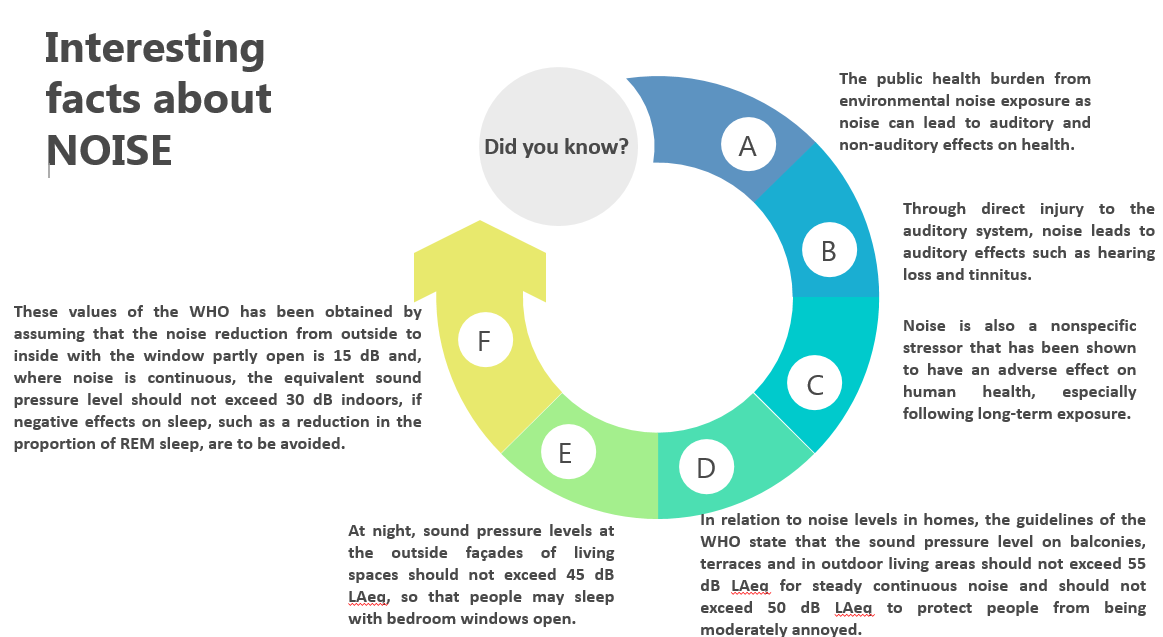
The level of noise exceeded the international standards as set by the World Health Organisation and most European countries (see the infographic above).
The medical documentation submitted by the applicant showed that her daughter suffered from a hearing impairment and that her condition required that she was not exposed to noise.
The Court founded that the level of disturbance reached the minimum level of severity which required the relevant State authorities to implement measures in order to protect the applicant from such noise (see Moreno Gómez, cited above, § 60).
The Court notes further that the applicant lodged her administrative claim on 25 June 2003 while the Administrative Court decided on it almost four years later, on 24 April 2007. In the Court's view such a long delay made the remedy used by the applicant ineffective and resulted in her suffering prolonged nightly exposure to excessive noise.
The national authorities allowed this situation to persist for almost eight years while the various proceedings before the administrative authorities and the Administrative Court were pending, thus rendering these proceedings ineffective.
In these circumstances, the Court finds that the respondent State has failed to discharge its positive obligation to guarantee the applicant's right to respect for her home and her private life. Accordingly, the Court finds that there has been a violation of Article 8 of the Convention and dismisses the Government's objections as to the applicability of Article 8 and the exhaustion of domestic remedies.
4. Relevance and significance of the judgment
Taking into account the large concentration of population in urban areas (cities), noise is a serious problem that directly affects the quality and health of people exposed to it. Although citizens have legally provided means by which they can protect their rights, from the perspective of the ECtHR's practice on this issue, it should be noted that Article 8 of the Convention is the main instrument of the Court that is used to protect the environment, and it is developed considerable practice on this issue based on this article.
The first indirect protection "par ricochet" of the human right to a healthy environment is related precisely to Article 8 of the Convention. According to the Court, the right to respect the home does not only include the right to an actual physical area, but also to the quiet enjoyment of this area within reasonable limits, which is significant especially in cases related to the high level of noise that violates this very aspect of the enjoyment of the right arising from this article;
The case of Oluić v. Croatia is a striking example of a less restrictive interpretation of Article 8 by the court compared to Article 2 (right to life). The court accepts different sources of injuries within article 8 while covering several types of pollution such as: air pollution, contamination of water supply, nuclear impact, accumulation of waste on public roads and of course noise;
While Article 8 should primarily protect the individual from arbitrary interference by public authorities in his private and family life, it also implies taking certain positive measures but also sanctioning failures of the state to regulate the operation of the state and private sector in an appropriate way to prevent or reduce harmful consequences (in this particular case, noise);
5. The impact of the judgement in Croatia
In 2019, a Law was passed on the State
Inspectorate, which was entrusted with supervision of eight ministries, including the Ministry of
Health. In this way, the performance of inspection supervision was centralized
and the lack of coordination was overcome. This legal concept has proven to be effective in practice.